Find the string
The guide grooves help position EBow around the string you want to play.

EBow / How it works
An electronic bow. A physical connection to your sound.
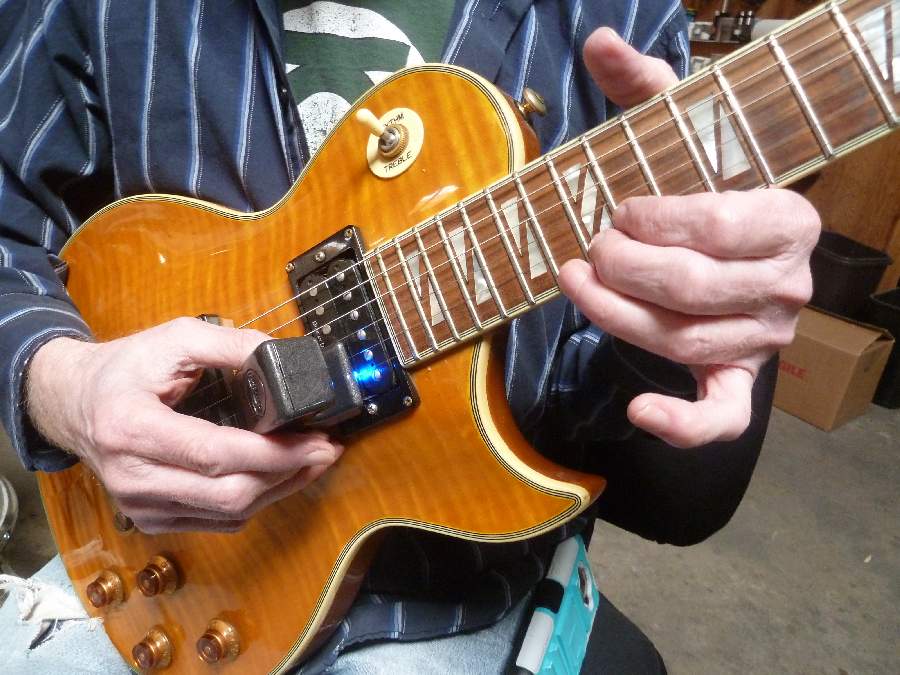
The guide grooves help position EBow around the string you want to play.
A focused magnetic field drives the string, sustaining its vibration.
Move along the string and vary proximity to explore attack, volume and texture.
Explore a sustained, singing tone.
Discover a brighter harmonic voice.
An electronic bow supplies energy directly to a guitar string. Instead of giving the string a single pick attack and allowing it to decay, the handheld device creates a focused magnetic drive field that keeps the vibration going. The manufacturer calls this Direct String Synthesis. A 9-volt battery powers the device; the guitar pickup receives the vibrating string in the usual way.
The useful distinction is where the action happens. An ordinary pedal receives an electrical signal from the guitar and changes that signal. Here, the device changes what the string is doing before the pickup converts its vibration into a signal. This lets the right hand influence a sustained note through position and movement rather than only through the initial attack. Your fretting hand still chooses the note, adds bends and shapes vibrato.
The field is focused on one string at a time. It is not a system that sustains every string of a chord simultaneously. Arpeggios and cross-string playing are possible because the device moves through successive string positions. That difference matters when you choose a technique: a held note, a bowed melody and a chord played as successive notes each use the same device in a different way.
The DriveChannel is the central channel beneath the device. For maximum drive, the chosen string runs along its centre and remains free to vibrate. The field comes from the LED end of the channel. The blue light illuminates the driven string, while the long guide grooves on either side help position the body on the neighbouring strings.
Those neighbours are support strings. They let you feel the aligned position without continually looking underneath the device. In basic sustain playing, the device rests on them but does not touch the central driven string. This is why contact and support should not be confused. More pressure on the support strings can bring the drive closer; pressing the channel into the driven string can instead cause noise or stop the vibration.
Alignment is essential. Twisting the device across the direction of the strings can move the string outside the effective field. A stable wrist, light initial pressure and a natural resting position give you a clearer starting point than force. The outside E strings are harder to support because there is only one neighbouring string available. Learn the central positions first, then adapt the grip and pressure for those edges.
The device’s distance from the selected magnetic pickup affects volume and tone. As it approaches the pickup, the signal grows and becomes brighter. Moving away gives a gentler sustained sound. This relationship supplies the dynamic movement used for bowing and swells. It also explains why a note can become unexpectedly loud after a small hand movement.
Distance from the string is a different control. Bringing the channel closer increases drive and can produce a quicker response; easing pressure reduces it. You can combine this with movement along the string, but learning each separately makes the result easier to understand. A loud change caused by approaching the pickup is not the same as a faster start caused by increasing drive.
The official guide recommends reducing guitar volume and treble during early practice. If the signal becomes too strong, adjust volume or retreat from the strongest playing area. Do not assume that a harsh result means the device needs more pressure. Listen for the distinction between strong magnetic drive and a string physically buzzing against the channel.
The basic instructions use the pickup nearest the fretboard, called the bass pickup in the guide. With only that pickup selected, there is a clear playing area to explore. Multiple pickups can change tone and reduce the level of the electronic-bow sound. Those combinations have uses, but they make the initial relationship between movement and response less straightforward.
Passive humbuckers provide a larger playing area and help moderate the extra treble. Single coils have a smaller area and a thinner tone, sometimes needing a reduction in highs. Active pickups may also benefit from reduced volume and treble. These are useful starting differences, not guarantees that every instrument will respond identically. Your first exercise is to find the usable area on the pickup you have selected.
The guide also discusses bridge-pickup and reverse-grip techniques. They produce other textures, but the strings become harder to drive near the bridge. Begin with the documented neck-pickup setup before treating those alternative positions as a beginner test. The first-use tutorial turns this setup into a repeatable sequence of actions.
Move from a little distance towards the neck pickup and listen for the strongest point. That is the HotSpot. A humbucker has two HotSpots with a weaker point between them. Finding these locations teaches you how a small change of position can alter the level and colour of a phrase.
You do not have to remain at the strongest point. Mellow sustain generally uses a position farther away. Spiccato benefits from a closer position, while cross-string bowing happens directly over the HotSpot. The guide uses this relationship to balance techniques in a phrase. Learning it gives you more useful control than treating the loudest response as the correct position for everything.
PlusEBow has two playing modes. Standard mode favours the fundamental, while harmonic mode encourages upper harmonics. Both retain the same basic need for alignment and free string vibration. The switch changes the drive behaviour; it does not turn the unit into a separate pedal that processes your output.
Position and fretting still influence harmonic content. In standard mode, notes close to the nut and movement away from the pickup can encourage harmonics. Bends and vibrato help them develop. In harmonic mode, gliding towards the pickup creates the wah-like effect described by the manufacturer. The dedicated lesson explains how to compare modes while keeping the other variables consistent.
The string drive does not depend on a loud amplifier feeding sound back into the guitar. The guide describes controlled sustain at any listening volume, including through headphones. Amplification is useful for hearing and shaping the result, but the loudspeaker is not what supplies the handheld device’s drive field.
Acoustic and bass applications require separate expectations. An acoustic guitar with a magnetic soundhole pickup responds more like an electric, while a piezo, bridge transducer or microphone gives a quieter result without the magnetic HotSpot needed for the same bowing strokes and spiccato. A bass has wider string spacing than the guitar spacing for which the guide grooves were designed. The manufacturer describes adapted alignment methods rather than a universal drop-in fit. The FAQ explains those limitations before you choose an exercise.
Content based on official EBow / Heet Sound learning materials.
Getting started with EBow →Learn harmonic mode →Questions and answers →Player’s Guide · Player’s Guide PDF · EBow Basics · Sound Clips ·
An amplifier or headphone setup helps you hear the result, but it does not supply the string drive. A 9-volt battery powers the handheld magnetic field.
It is a sound-shaping tool acting directly on the string. A conventional pedal processes the electrical output instead.
Yes. The official guide describes controlled sustain at low listening levels and through headphones, without loudspeaker feedback.
It continues supplying magnetic drive while the string remains correctly aligned and free to vibrate in the DriveChannel.